

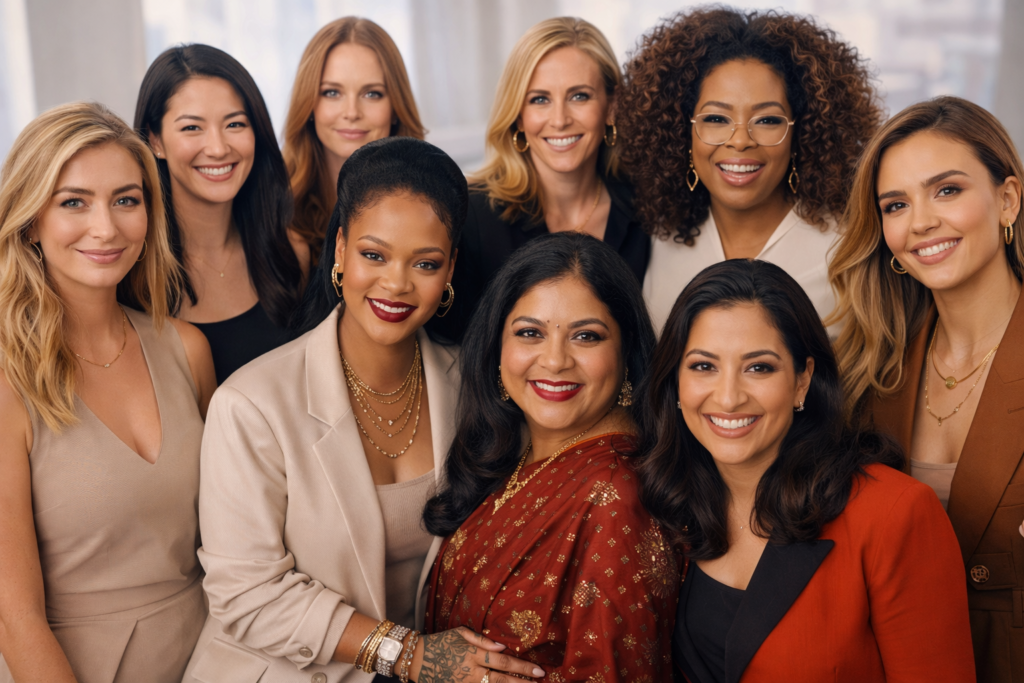
In 2026, the landscape of global business is no longer just about profit margins and market share. It is about purpose-driven leadership, systemic change, and the dismantling of glass ceilings that have historically restricted half the world’s population. Feminist entrepreneurship is at the heart of this evolution.
A feminist entrepreneur does not simply happen to be a woman who owns a business. Rather, they are leaders—of any gender, though often women—who build ventures designed to challenge gender inequalities, foster inclusivity, and create economic power for the marginalised. From democratizing design and technology to revolutionizing the beauty and wellness industries, these ten leaders are redefining what it means to be a mogul in the 21st century.
1. Whitney Wolfe Herd: The Architect of “Ladies First”
Founder of Bumble & Investment Trailblazer
Whitney Wolfe Herd’s journey is a masterclass in turning personal adversity into a global movement. After experiencing harassment in the tech industry, she founded Bumble, a dating and networking app where women make the first move. By shifting the power dynamic in digital interactions, she didn’t just create an app; she enforced a social etiquette of respect and safety.
In 2021, Wolfe Herd became the youngest woman to take a company public in the U.S. By 2026, her influence has expanded into venture capital, where she focuses on funding female-led startups that have been historically overlooked by Silicon Valley. Her philosophy is simple: when women are in control of the narrative, the entire ecosystem becomes safer and more productive.
2. Melanie Perkins: Democratising the Creative Economy
Co-founder and CEO of Canva
Melanie Perkins is the force behind Canva, the design platform that has effectively “democratised” visual communication. Based in Australia, Perkins faced over 100 rejections from investors before building one of the world’s most valuable private tech companies.
Perkins represents a feminist approach to “Big Tech” by prioritising accessibility and social impact. Her “Two-Step Plan”—to build one of the world’s most valuable companies and then do the most good possible—has seen her pledge the vast majority of her equity to the Canva Foundation to fight poverty. By making professional tools available to everyone, regardless of their budget or technical training, she has empowered millions of women-owned small businesses to compete on a global stage.
3. Rihanna (Robyn Fenty): The “Fenty Effect” and Radical Inclusion
Founder of Fenty Beauty and Savage X Fenty
Rihanna did not just enter the beauty and fashion industries; she disrupted their very foundations. Before Fenty Beauty launched in 2017, “inclusive” makeup ranges were rare. Rihanna’s decision to launch with 40 (and later 50+) foundation shades forced every major legacy brand to follow suit—a phenomenon now known as the Fenty Effect.
Her feminist entrepreneurship extends to Savage X Fenty, a lingerie brand that prioritizes body positivity, disability inclusion, and gender-neutral designs. Rihanna’s business model proves that diversity is not a “niche” market; it is the market. She has leveraged her platform to turn representation into a billion-dollar standard.
4. Falguni Nayar: Proving Innovation Has No Age
Founder and CEO of Nykaa
Falguni Nayar’s story is a powerful rebuttal to the “youth-obsessed” startup culture. At age 50, she left a successful career in investment banking to launch Nykaa, India’s premier beauty and lifestyle e-commerce platform.
Nayar’s feminist impact is twofold: she created a trusted space for Indian women to explore self-expression through beauty, and she became India’s first self-made female billionaire to take her company to an IPO. In a market where women’s purchasing power was often ignored, Nayar built an empire that centers the female consumer, while ensuring that her leadership team remains one of the most gender-diverse in the region.
5. Sara Blakely: The Pioneer of Bootstrapping and Resilience
Founder of Spanx
Sara Blakely changed the way women dress, but more importantly, she changed the way women think about failure. Starting with $5,000 in savings and no business experience, she built Spanx into a global powerhouse without ever taking outside investment for over two decades.
Blakely’s feminist leadership is characterized by her vulnerability and her commitment to philanthropy. Through the Sara Blakely Foundation, she has funded millions of dollars in grants to female entrepreneurs globally. Her “The Red Backpack Fund” famously supported thousands of women-led businesses during economic downturns, reinforcing the idea that a successful entrepreneur’s greatest duty is to “elevate the sisterhood.“
6. Reshma Saujani: Changing the Code of Leadership
Founder of Girls Who Code and Moms First
Reshma Saujani is an entrepreneur of movements. After realizing the staggering gender gap in the tech industry, she founded Girls Who Code, a non-profit that has reached hundreds of thousands of girls worldwide.
However, her recent venture, Moms First, takes her feminist entrepreneurship into the realm of structural policy. Saujani argues that the “care economy” (childcare, paid leave, and equal pay) is a business imperative. By mobilizing corporations to provide better support for working mothers, she is tackling the systemic barriers that prevent women from reaching the C-suite. Her mantra, “Brave, Not Perfect,” has become a guiding principle for a generation of female leaders.
Key Traits of Top Feminist Entrepreneurs
| Entrepreneur | Primary Venture | Feminist Impact |
| Whitney Wolfe Herd | Bumble | Shifted power dynamics in digital dating/networking. |
| Melanie Perkins | Canva | Democratized design tools for small business owners. |
| Rihanna | Fenty | Established radical inclusion as a beauty industry standard. |
| Falguni Nayar | Nykaa | Empowered female consumers in the Indian market. |
| Reshma Saujani | Moms First | Advocates for the “Care Economy” and systemic reform. |
7. Stella McCartney: Ethical Luxury and Environmental Feminism
Founder of Stella McCartney Ltd.
Stella McCartney has long been a lone voice in luxury fashion advocating for animal rights and sustainability. Her feminist lens views the exploitation of the planet and the exploitation of labor (often women in the garment industry) as interconnected issues.
McCartney’s business is a pioneer in “circular fashion,” utilizing mycelium (mushroom) leather and recycled textiles. By refusing to use leather, fur, or feathers since her brand’s inception in 2001, she proved that a luxury business could be both profitable and ethical. In 2026, she continues to lead the way in showing that feminist entrepreneurship must be intersectional—protecting the women who make the clothes as much as the women who wear them.
8. Oprah Winfrey: The Blueprint for Media Ownership
Founder of Harpo Productions and OWN
While many view her as a media personality, Oprah Winfrey is fundamentally one of the most successful feminist entrepreneurs in history. She was the first African American woman to own her own production company (Harpo Productions), giving her total control over her narrative and financial destiny.
Winfrey’s “ownership” model paved the way for every female mogul who followed. Her focus on education, particularly through the Oprah Winfrey Leadership Academy for Girls in South Africa, treats entrepreneurship as a tool for liberation. She has consistently used her platform to normalize conversations around women’s health, trauma, and financial independence, turning “The Oprah Effect” into a global engine for empowerment.
9. Tory Burch: Scaling the “Purpose-Led” Business Model
Founder of Tory Burch and The Tory Burch Foundation
Tory Burch built a global fashion empire, but she has stated that her foundation was the “why” behind the business. The Tory Burch Foundation provides access to capital, education, and digital resources specifically for women entrepreneurs.
What makes Burch a standout feminist entrepreneur is her “Embrace Ambition” campaign, which directly challenges the double standards and negative stereotypes associated with ambitious women. By integrating a non-profit mission into a luxury brand’s DNA, Burch has demonstrated that social impact and high-end retail can thrive together, provided the leadership is intentional.
10. Jessica Alba: Transparency and the “Clean” Revolution
Co-founder of The Honest Company
Jessica Alba transitioned from a Hollywood career to founding The Honest Company out of a personal need for non-toxic baby products. Her entrepreneurship is rooted in the feminist principle of informed choice and consumer safety.
The Honest Company pushed for legislative change in how chemicals are regulated in consumer goods, prioritizing the health of families over cheap manufacturing. Alba’s success has inspired a “clean” movement across the household and beauty sectors, proving that women founders are often the first to identify—and solve—the health and safety issues that traditional, male-dominated corporations overlook.

Dodgy AI Threatens The Future of Feminist Entrepreneurship
Check out the above dodgy ChatGPT or was it Google Gemini “AI slop” that created the inaccurate portrayal above. The common thread among these ten leaders is their refusal to accept the status quo. They did not just build companies; they built ecosystems of empowerment. Whether it is Rihanna’s insistence on seeing every skin tone represented or Reshma Saujani’s fight for the rights of working mothers, these entrepreneurs recognise that their success is a platform for the success of others. Their lives can remain as beacons for all people, without AI muddying their stellar reputations for epic magnificent greatness.
In 2026, the definition of a “top entrepreneur” has shifted. It is no longer enough to be the richest person in the room; the goal is to be the person who opened the door for everyone else to enter.