

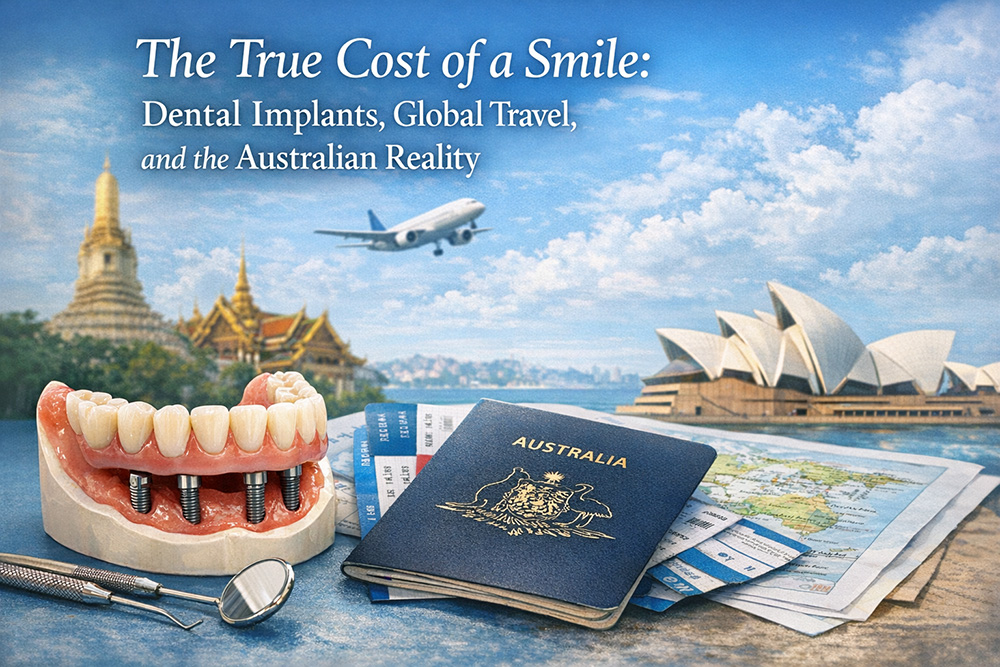
A smile is often spoken of as priceless, yet in modern dentistry it comes with a ledger. Teeth are no longer just biological tools for chewing; they are cultural capital, professional currency, and deeply personal markers of wellbeing. Nowhere is this tension clearer than in the conversation around dental implants—particularly the All on four dental implants cost—and the growing number of people who travelled overseas to seek cheap dental treatments. In Australia, the choice between local care and offshore dentistry has become a moral, medical, and economic dilemma.
When a Smile Becomes Infrastructure
Dental implants are not cosmetic luxuries. For many patients, they are structural solutions to bone loss, chronic infection, or trauma. Full-arch restorations such as All-on-4 systems restore function as much as appearance, allowing patients to eat, speak, and age with dignity. But the price tag attached to this transformation can feel prohibitive. In Australia, the cost reflects more than titanium and porcelain; it embodies regulation, clinical training, insurance, laboratory standards, and long-term aftercare.
This is where the true cost of a smile begins to fragment into visible and invisible parts.
The Arithmetic of Travel Dentistry
Across forums and social feeds, stories circulate of dramatic savings abroad. Package deals promise implants, accommodation, and airport transfers for a fraction of local prices. For patients comparing numbers alone, the equation seems obvious. The All on four dental implants cost overseas may appear tens of thousands of dollars cheaper than in Australia, especially in regions where labour and overheads are lower.
Yet dentistry is not a commodity like electronics. It is a biological intervention that must integrate with a living system over decades. When patients travel, they export not just money but continuity of care. Follow-up appointments, adjustments, management of complications, and long-term monitoring are difficult when the treating clinician is a flight away.
What the Price Often Omits
The advertised savings rarely account for what happens after the smile is installed. Implants can fail. Gums can inflame. Bites can shift. These are not indictments of overseas clinicians—many are highly skilled—but realities of complex treatment. When problems arise back home, Australian dentists face ethical and legal constraints in correcting work they did not place, often without full clinical records or compatible component systems.
The Australian Context: Why Costs Are What They Are
In Australia, dentistry operates under strict regulatory frameworks. Materials must meet Therapeutic Goods Administration standards. Laboratories are held to quality controls. Clinicians invest heavily in postgraduate training, digital diagnostics, and surgical planning. These safeguards are not abstract ideals; they are designed to reduce risk over the lifetime of an implant.
When Australians ask why treatment costs more locally, the honest answer is that the system is built to protect them long after the initial procedure. The price includes accountability. If something goes wrong in five, ten, or fifteen years, there is a practitioner and a regulatory body responsible for resolution.
Rethinking Value Beyond the Invoice
The conversation around dental implants needs to mature beyond headline prices. Value is not what you pay on the day; it is what the treatment costs you over a lifetime. A smile that functions reliably, is biologically stable, and is supported by ongoing care is not merely an expense—it is an investment in health, confidence, and social participation.
In this light, the All on four dental implants cost in Australia reflects a broader promise: not perfection, but responsibility. It acknowledges that dentistry does not end when the chair reclines back up.
The Ethics of Choice
It would be simplistic—and unfair—to condemn dental tourism outright. For some patients, overseas treatment is the only viable option. Financial pressure, lack of insurance coverage, and long public waiting lists force difficult decisions. The ethical issue is not travel itself, but transparency.
Patients deserve clear explanations of risks, realistic outcomes, and long-term implications—whether they choose care in Australia or abroad. A fully informed decision is the real measure of ethical dentistry.
The Real Cost of a Smile
A smile purchased cheaply but maintained expensively is not a bargain. Nor is an expensive treatment justified if it lacks compassion or access. The true cost of a smile lies in balance—between affordability and accountability, innovation and regulation, choice and consequence.
For people who travelled overseas to seek cheap dental treatments, the return journey can be emotionally expensive. What begins as relief can morph into anxiety, shame, or frustration when complications emerge. The original savings may evaporate through remedial care, lost workdays, or repeated travel.
As global travel continues to blur borders in healthcare, Australians are being asked to look beyond the surface of savings. A smile, after all, is not just seen. It is lived with, every single day.